Friday, September 9, 2022

Tomorrow: The Minister of Happiness vs. The Secretary of Swing

Yesterday afternoon, I was talking with a tennis fan, and I told her to be sure and watch the first semifinal on Arthur Ashe because it would be so exciting. Imagine my surprise when it was not only not exciting, but also a one-sided shut-down. I don't know what happened to Cincinnati champion Caroline Garcia (I don't accept Chris Evert's "She peaked too early" explanation--Garcia is made of better stuff than that), but she was a mere shadow of the player who won Cincinnati and cruised through the first five rounds of the U.S. Open

My comment isn't intended to take anything away from Garcia's opponent, Ons Jabeur, who was certainly a big part of what happened to Garcia. Jabeur, who is always difficult to play because of her creative shot-making, also brought an on-fire serve to her semifinal match against Garcia. The Tunisian star hit eight aces and 21 winners in the 66-minute match, in which she never gave her opponent a single chance to break. Still, considering the brilliance of Garcia's 13-match win streak, her 1-6, 3-6 loss was a big surprise.

The second semifinal was a different story altogether. Aryna Sabalenka, in the U.S. Open semifinals for the second year in a row, had to deal with world number 1 Iga Swiatek, normally a formidable task. But Swiatek hasn't looked that comfortable throughout the New York event, and it wasn't unreasonable to think that the huge-hitting Sabalenka might be the one to stop her run.

Sure enough, the sixth seed easily overwhelmed Swiatek in the first set, which she won, 6-3. The loss apparently woke Swiatek up, because--as I like to say--when she returned to the court for the second set, she remembered who she was. Swiatek steamrolled Sabalenka 6-1.

The third set was exactly what one would have expected--a tight contest in which the momentum rapidly shifted. At 4-all, the tension was palpable. But it was the world number 1 who--once again, remembering who she was--brought the whole thing to a close with a 3-6, 6-1, 6-4 victory.

Here are the players' paths to the final:

IGA SWIATEK (1)
round 1-def. Jasmine Paolini
round 2--def. Sloane Stephens
round 3--def. Lauren Davis
round of 16--def. Jule Niemeier
quarterfinals--def. Jessica Pegula (8)
semifinals--def. Aryna Sabalenka (6)

ONS JABEUR (5)
round 1--def. Madison Brengle
round 2--def. Elizabeth Mandlik
round 3--def. Shelby Rogers
round of 16--def. Veronika Kudermetova (18)
quarterfinals--def. Ajla Tomljanovic
semifiunals--def. Caroline Garcia (17)

Also yesterday, 3rd seeds Barbora Krejcikova and Katerina Siniakova won their semifinal match. If the Czech pair wins the U.S. Open, they will be the owners of what I've decided to name the Super Golden Career Slam. Stay tuned.

And also yesterday: Top seed Diede De Groot won her quarterfinal match when her opponent retired, and she and partner Aniek Van Koot won their quarterfinal doubles match.

Wednesday, September 7, 2022

Down to four

In yesterday's quarterfinal competition, Ajla Tomljanovic--now a household word because she defeated Serena Williams in her final U.S. Open match--made her own exit from the Open at the hands of close friend and Wimbledon finalist Ons Jabeur. Jabeur was frustrated throughout parts of the match, threw a couple of rackets, and worried later that "I think I'm going to be fired from my job as Minister of Happiness."

But she persevered by keeping up with Tomljanovic's hard hitting, and by grabbing more of the key points. Despite occasionally being somewhat rattled, Jabeur displayed a keen tennis intelligence throughout the match, and hit more than twice as many winners as Tomljanovic. Hitting as hard and precisely as her opponent, and using her well-known variety of shots, the Tunisian star prevailed, 6-4, 7-6. The tiebreak "should" have been tension-filled, but Tomljanovic saw nerves creep in at that point, which made it easier for Jabeur to close the match.

In Tuesday's other quarterfinal, Caroline Garcia posted a 78 first serve win percentage, and she was successful at the net in 81% of her attempts. Those stats would make anyone hard to beat, and indeed, Garcia won the match against Coco Gauff 6-3, 6-4. Garcia was in a major slump for a very long time, and she has dramatically pulled herself out of it, winning Cincinnati, and now reaching the semifinals of the U.S. Open.

Garcia is known for "flying" after a victory, and her stylish French plane has been on view a lot lately. Aryna Sabalenka, on the other hand, may have channeled her inner Lockheed Blackbird when she met Karolina Pliskova in their quarterfinal match today. 

Pliskova, who broke her wrist at the beginning of the season, has finally come back into form, but not quite enough to do much about her opponent. Sabalenka hit seven aces, and had first and second serve win percentages of 72 and 63. Most significant--Pliskova never saw a break opportunity; Sabalenka was too powerful and too fast. The 2016 finalist picked up her level considerably in the second set, but Sabalenka would have none of it--she won their match 6-1, 7-6, and reached the U.S. Open semfinals for the second straight year.

In the night match, world number 1 Iga Swiatek faced off against the USA's number 1 player, Jessie Pegula, who is seeded number 8 in New York. Swiatek won the first set with relative ease, but the second set was another thing altogether. Pegula became more aggressive, as Swiatek experienced periods in which she made repeated unforced errors. In the end, though, it was the Polish star who knew what to do, and she defeated Pegula 6-3, 7-6. This is the first time that Swiatek has reached the semifinals of the U.S. Open. 

Here is the semifinal draw:
Iga Swiatek (1) vs. Aryna Sabalenka (6)
Caroline Garcia (17) vs. Ons Jabeur (5)

In other U.S. Open news, 3rd seeds Brbora Krejcikova and Katerina Siniakova advanced to the semifinals today, as did 13th seeds Caroline Dolehide and Storm Sanders (who defeated Caroline Garcia and Kiki Moadenovic). And defending champion Diede De Groot advanced to the semifinals in women's wheelchair competition.

Monday, September 5, 2022

U.S. Open quarterfinals set

I could sense it coming, and--unfortunately--it did: Petra Kvitova, who has been on fire at this U.S. Open, put up a half-spirited resistance against round of 16 opponent Jessie Pegula in today's first match, allowing Pegula to easily defeat her, 6-3, 6-2. The Czech player served well, but she made twice as many unforced errors as Pegula, who broke her six times. This "should" have been a tightly contested, entertaining match, but almost from the moment she stepped onto the court, the Czech star looked depleted. We have seen this pattern over and over with Kvitova, and it's very unfortunate.

This is to take nothing away from Pegula, who is staying calm and playing at a consistently high level.

World number 1 Iga Swiatek had her hands full in the first set of her match against Jule Niemeier, whose quarterfinal match at Wimbledon was, in my opinion, the finest match played at that event. But Swiatek, as she so often does, solved the problem, and returned to win the next two sets, posting a 2-6, 6-4, 6-0.

Vika Azarenka served for the first set at 5-4 in her round of 16 match against 2016 runner-up Karolina Pliskova, but she was broken (in the final point, she broke herself by double-faulting), and Pliskova went on to take that set 7-5. Again, Azarenka took the lead in the second set, again, Pliskova caught up, but eventually lost the set in a tiebreak. Nevertheless, she prevailed, 7-5, 6-7, 6-2.

The final round of 16 match was played between Danielle Collins and Aryna Sabalenka. It was notable partly because Collins could not find a first serve. It was equally notable because her abysmal service stats didn't seem to bother her; she got creative with her second serve, and she went to work on Sabalenka's serve. The degree of mental energy that Collins preserved by just accepting that she was having a bad serving night and getting on with things was likely quite high.

Collins took the first set. In the grueling seventh game of the second set, Sabalenka saved seven game points, and then had treatment for her left thigh. Her serve intact, she went on to win the second set, after which she received some sort of leg treatment. But something else had happened, too: It was as if someone had pulled a plug and let all the air out of Collins. She had practically been willing herself to win points, and suddenly, she was just a good player without much of a serve who was being dominated by a steam-rolling opponent. 

When Sabalenka served at 4-1 in the third set and was broken, it looked like Collins might come back to life, but she was broken back in the next game, and Sabalenka proceeded to successfully serve for the match. Her 3-6, 6-3, 6-2 victory was hard-won, despite her opponent's issues. Between them, the players hit 72 winners and made 63 unforced errors, including 20 double faults.

Here is the quarterfinal draw:

Iga Swiatek (1) vs. Jessie Pegula (8)
Karolina Pliskova (22) vs. Aryna Sabalenka (6)
Coco Gauff (12) vs. Caroline Garcia (17)
Ons Jabeur (5) vs. Ajla Tomljanovic

There have already been three major upsets in doubles, though one of them is more of an upset on paper than anything else. Top seeds Veronika Kudermetova and Elise Mertens were defeated in the second round by the unseeded team of Kirsten Flipkens and Sara Sorribes Tormo, and 2nd seeds Coco Gauff and Jessie Pegula went out in the first round to the unseeded team of  Leylah Fernandez and Daria Saville. 4th seeds Lyudmyla Kichenok and Alona Ostapenko lost in the third round to 14th seeds Caroline Garcia and Kiki Mladenovic, but that team's seeding doesn't really reflect their level of competence.

About last night

Both Caroline Garcia and Coco Gauff won their round of 16 matches yesterday in fairly straightforward fashion, though Gauff got quite a challenge from Zhang Shuai. Not so the for the night matches, in which Ajla Tomljanovic and Ons Jabeur took the scenic--and by "scenic," I mean "crazy curves over cliffs with potential rock slide activity"--route.

Liudmila Samsonova, arguably the hottest competitor on the tour right now, stepped onto Louis Armstrong Stadium on a 13-match win streak. She went up 5-2 in the first round, looking for all the world like she was headed for number 14, but then things went wrong. One of the things that went wrong was that Samsonova's already-fragile knee became more fragile as the match wore on. The Russian player looked tired, and she made repeated unforced error,

The other thing that went wrong for Samsonova was that her opponent played better as the match progressed. Tomljanovic won the first set in a 10-8 tiebreak--after "pulling a Serena" and saving eight set points in the ninth game, which lasted 18 minutes and featured 12 deuce points. By the second set, Samsonova was a mere shadow of herself, and Tomljanovic took that set 6-1. 

Then there was Ons Jabeur, who had to face her nemesis, Veronika Kudermetova, whom she had never defeated. Kudermetova is a double threat: She hits the ball flat and very hard, but she's also an excellent doubles player, so she has exceptional net skills. 

Once again, the perhaps-favored player, Kudermetova, led 5-2 in the first set. Jabeur looked somewhat tentative, remaining on the baseline (which isn't where she does her best work), but then some switch got turned on, and Jabeur began to work her special magic against the Russian. Jabeur took the set to a tiebreak, in which she all but ran over (7-1) Kudermetova, then she won the second set 6-4.

Now Tomljanovic and Jabeur will meet in the quarterfinals, and we'll see what kind of route they decide to take.

Saturday, September 3, 2022

Round of 16 set at U.S. Open

Today's U.S. Open lineup was not for the faint of heart. First, Garbine Muguruza and Petra Kvitova put us all through the tiebreak from hell (which isn't to say that it wasn't exciting), but--just in case your heart rate didn't go up enough--Alizé Cornet and Danielle Collins put us through a second one. Both matches were well-played and great fun to watch.

The only result that might be called an upset was Belinda Bencic's win over Karolina Pliskova, but considering Pliskova's ability and history, I don't really put it into the "upset" category (except on paper).

Jule Niemeier, who played in my favorite Wimbledon match, defeated the talented Zheng Qinwen.

Here is the round of 16 draw:

Iga Swiatek (1) vs. Jule Niemeier
Petra Kvitova (21) vs. Jessie Pegula (8)
Vika Azarenka (26) vs. Karolina Pliskova (22)
Danielle Collins (19) vs. Aryna Sabalenka (6)
Zhang Shuai vs. Coco Gauff (12)
Caroline Garcia (17) vs. Alison Riske-Amritraj
Ons Jabeur (5) vs. Veronika Kudermetova (18)
Liudmila Samsonova vs. Ajla Tomljanoivic

Some facts about the draw

Swiatek reached the round of 16 last year, but was upset by Belinda Bencic.

Azarenka has reached the final of the U.S. Open on three occasions.

This will be Collins' first U.S. Open round of 16 competition.

Kudermetova has yet to drop a set and is yet to be broken.

Samsonova is on a thirteen-match win streak.

The last twirl

If you're watching the U.S. Open and you're a serious tennis fan, you may feel exhausted by now--I know I do. Top seeds falling in the first and second rounds, the defending champion going out in the first round, ESPN's failure to deliver anything but consistently trashy streaming, and Serena Williams making one last--and very dramatic--appearance on Arthur Ashe Stadium. 

It was never going to be easy against Ajla Tomljanovic, one of those players who rises to the occasion at majors (though, oddly, nerves have tended to do her in at regular tour events--go figure). The Australian, however, is a very good player, despite her not having the titles to show for it. And from the moment she entered Arthur Ashe Stadium, she appeared to be in a kind of personal, protective, bubble. 

It served her well, as the crowd would go on to cheer all of her faults and sit in stone silence when she hit winners. The chair umpire "tried" to take control of the crowd, but it was a half-hearted, fruitless effort. No matter--Tomljanovic hit them anyway.

The match went to a third set (with Williams winning the second in a tiebreak), and Tomljanovic, certainly aware of Williams' lack of match play, refused to fade, unlike so many others who have had to face Third Set Serena. At 1-5 down, however, Serena gave the crowd what they wanted--the kind of relentless defense that has worn down many a player with credentials much more impressive than Tomljanovic's. She saved five match points, but Tomljanovic won, 7-5, 6-7, 6-1, in a dramatic contest that lasted over three hours.

The post-match atmosphere was memorable, between Serena's lovely and emotional goodbye and Tomljanovic's perfectly hit notes of respect, admiration and humor. ESPN's Alexandra Stevenson mentioned, after the match, that she had recently had an encounter with Tomljanovic that had left her convinced that the Australian player had entered a different mental zone. If that's true, players should watch out; Tomljanovic has always had the talent and skills.

A favorite of some to win the Open, Simona Halep, seeded 7th, was taken out in the first round by world number 124 Daria Snigur. Defending champion Emma Raducanu also made an exit in the opening round; Raducanu lost to resurgent French veteran Alizé Cornet. Wimbledon champion Elena Rybakina lost to  world number 131 Clara Burel, two-time champion Naomi Osaka lost to (an obviously recovered) Danielle Collins, and 10th seed Daria Kasatkina was defeated in the first round by Harriet Dart. 2019 champion Bianca Andreescu lost in the opening round to Harmony Tan.

Both 3rd seed Maria Sakkari and 4th seed Paula Badosa were defeated in the second round. Sakkari lost to Wang Xiyu, and Badosa was defeated by Petra Martic.

In other news, the always-under-the-radar Veronika Kudermetova has yet to drop a set.

Friday, September 2, 2022

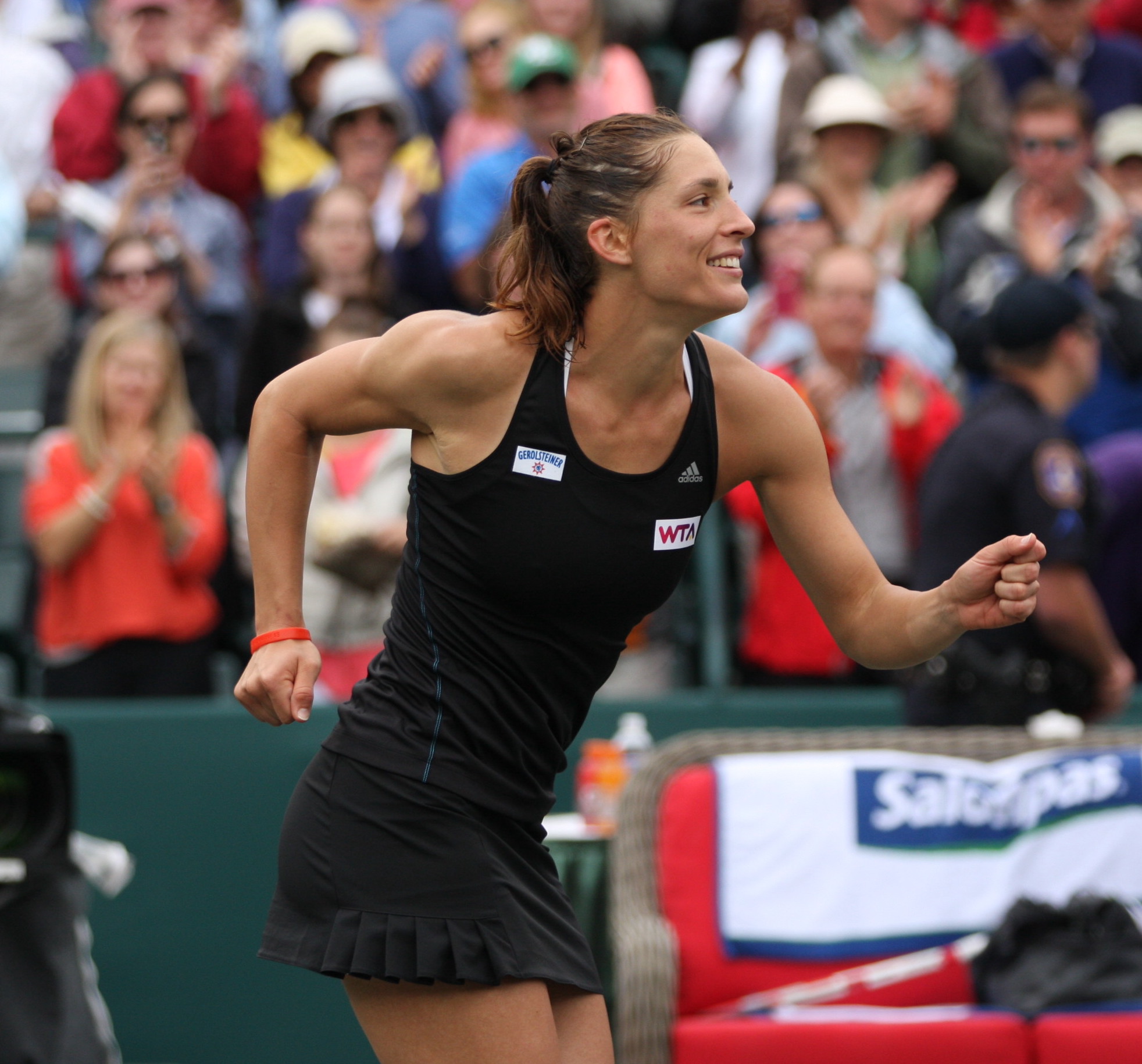
Andrea Petkovic dances off the court and into the future

photo by Daniel Ward

Andrea Petkovic, the thoughtful, intelligent, creative, and enormously well-liked German player with the crowd-pleasing dance moves, announced her retirement from professional tennis after her first round match at the U.S. Open this week. Petkovic, who is 34, said that "...I still love the game, still have a tremendous amount of passion for the game. It's more the body that is not allowing me to play tennis anymore in a way that I want to play it, train the way I want to train, just play a full season really."

Petkovic lost to Switzerland's Belinda Bencic, and remarked later that "I was glad that it ended like this, with Belinda, somebody I love and respect so much."

The German star reached a career-high ranking of number 9 in the world in 2011. She won seven singles titles, reached the semifinals of the French Open in 2014, and reached three other major quarterfinals. She  spent nine years playing on the German Fed Cup team, and was a member of the German Olympic team in 2016.

Sadly, Petkovic's career was riddled with injuries--her neck, knees, thigh, and lower back all put her out of commission, sometimes for long periods of time, and she made some remarkable comebacks.

photo by Daniel Ward 

Petkovic's interests were always broad and varied: On a given day, she could be reading Goethe, writing poetry, going to museums--or watching basketball, enjoying rock music, and making hilarious videos; she named her video-producing alter ego Petkorazzi. Petko, as she is known by fans, is also known for her post-victory on-court dances. At one point, she became tired of doing the Petko Dance, and declared that she would no longer do it, but fans were insistent, so she continued the ritual, though usually in abbreviated form.


If you're goal is to provide the best in silliness and entertainment, you may sometimes need a partner, and who better in the category of hilarity than Jelena Jankovic? Petkovic and Jankovic (whose doubles matches were shows in themselves) made a series of videos in Charleston that are WTA classics.


Petkovic said, in announcing her retirement, that she may play an exhibition in Germany later this year. 

"I did feel," she said, "this year also for the first time that my narrative has been told and is not relevant anymore in a way, that the new generation is taking over. I think I brought everything to the game that I had to give. Obviously it's not in an amount as Serena, but in my own little world, I feel like I brought everything to it and my narrative was done."

That may be true, but for fans, the Petkovic narrative will long continue in memory as an exemplary story of perseverance, sportswomanship, athleticism, generosity, and absolute delight.